





Having officially joined the IWC on December 30, 2025, Türkiye will participate in the commission’s biennial decision-making General Assembly for the first time as a member state and will cast its first-ever vote on crucial resolutions that will directly affect the future of whales. One of these is commercial whaling. However, reports emerging in the Japanese press ahead of IWC70 have laid bare the diplomatic contacts between the pro-whaling lobby and Türkiye.
Türkiye to cast its first vote
The 70th meeting of the International Whaling Commission (IWC) is taking place in Hobart, Australia, from September 27 to October 2, 2026. Ahead of this critical meeting, attended by officials from Türkiye’s Ministry of Agriculture and Forestry and the General Directorate of Fisheries and Aquaculture, our expectation is clear: Türkiye must unequivocally say “NO” to the resolution that aims to pave the way for commercial whale slaughter.
Turkish Ambassador ate whale meat with whaling executives
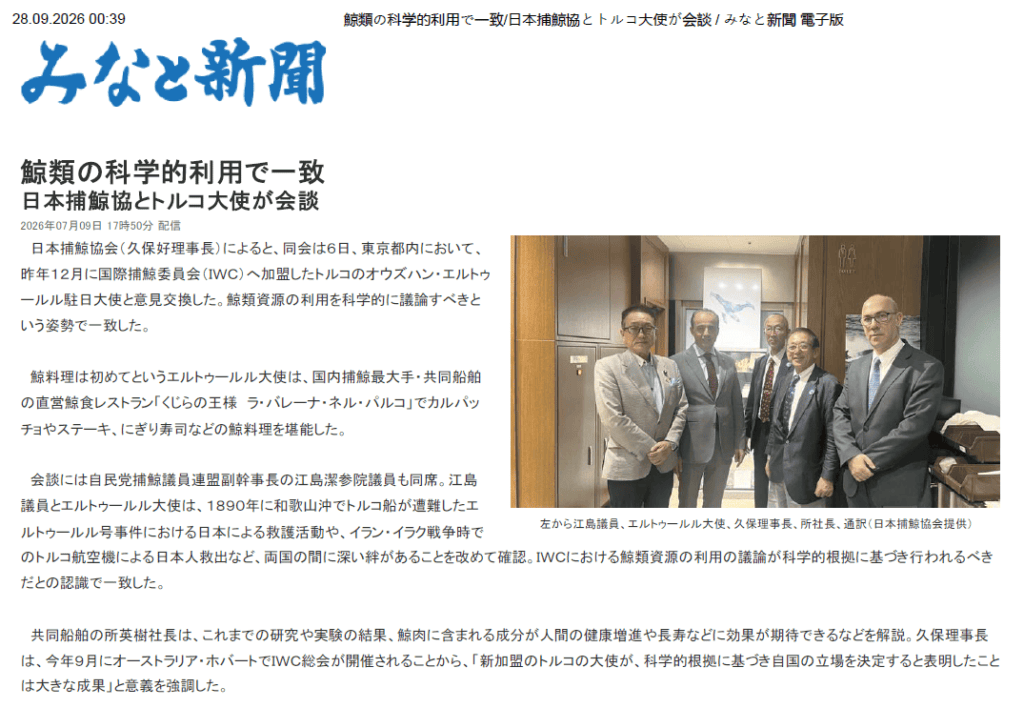
According to reports by the Japanese local press, Minato Shimbun, and the Suisan Keizai Shimbun newspaper; on July 6, 2026, in Tokyo, Türkiye’s Ambassador to Japan, Oğuzhan Ertuğrul, met with Yoshimitsu Kubo, Chairman of the Japan Whaling Association (JWA), and Hideki Tokoro, President of Japan’s largest commercial whaling company, Kyodo Senpaku.
During this dinner meeting at a whale meat restaurant owned by Kyodo Senpaku, it was stated that an “agreement” was reached that IWC decisions should be based on “scientific evidence,” which is the primary cover used by pro-whaling lobbies.
Furthermore, the reports explicitly stated that the Turkish Ambassador was served whale meat as carpaccio, steak, and nigiri sushi for the first time, and that the ambassador ate all the whale meat on the menu.
Türkiye’s IWC membership process
After a long process, Türkiye joined the commission on December 30, 2025, becoming the 89th member of the IWC. Türkiye’s purpose for joining this commission was defined in official statements as “contributing to the evaluation of scientific studies regarding marine mammals and the protection of whale species.” Now, the Turkish delegation must stand behind this “protection” commitment.
A covert resolution to breach the ban
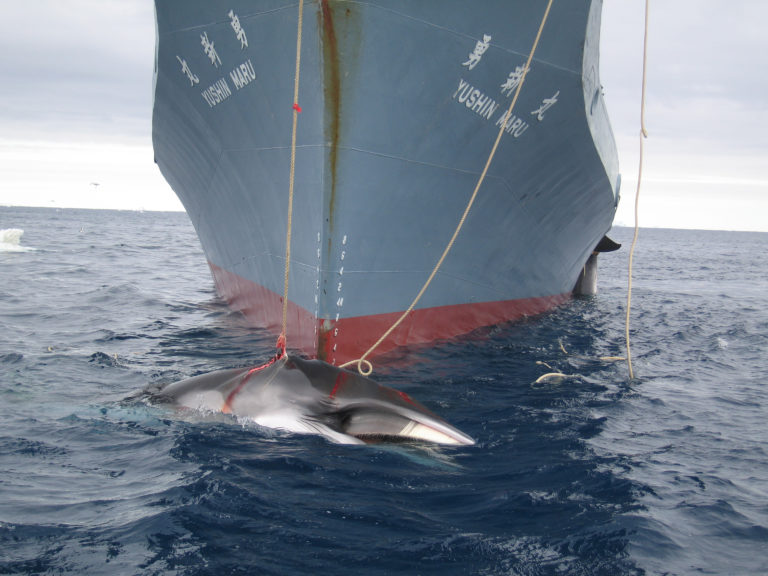
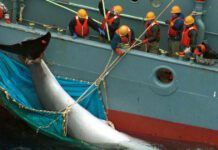
The commercial whaling moratorium, in effect since 1986, has saved hundreds of thousands of whales from extinction. However, on the IWC70 agenda, there is a dangerous resolution sponsored by Japan and spearheaded by Antigua and Barbuda, which aims to restart commercial whaling under the guise of the “sustainable use of whale stocks.” Yet, the commercial reality behind the guises of “scientific research” or “sustainable use” was registered in 2014 when the International Court of Justice (ICJ) ruled it to be a purely commercial slaughter.
The resolution brought back to the table today at IWC70 is an attempt to reopen the door to exploitation—which international law had closed—through new wordplay and diplomatic backchannels.
- Indeed, the phrase “harvesting of whale resources” in the resolution text defines animals with the word “harvest,” as if they were crops to be reaped or a mine to be consumed.
- Similarly, the phrase “orderly development of the whaling industry” is a clear admission that the true goal hiding behind the words “sustainability” and “conservation” is to resurrect and perpetuate the profit-driven commercial industry.
- The phrase “food security and poverty reduction” is one of the most prominent examples of concrete manipulation. Even though whale meat and body parts are used as luxury consumption products and cosmetic raw materials, pro-whaling bodies try to make commercial whaling activities acceptable by presenting them under the mask of “fighting poverty.”
The danger of diplomatic bargaining
The IWC’s decision-making processes have historically been the stage for diplomatic maneuvers where the right to life of animals was subordinated to the economic and commercial interests of countries. We call on the Turkish delegation, at this table where it will cast its first vote, not to be a party to any diplomatic bargaining that sacrifices the animals’ right to life for narratives of “historical friendship” or economic interests.
Exclusion of civil society and the media
Forcing civil society and the media out the door at critical moments during IWC meetings is one of the commission’s common censorship tactics. Prior to the most critical votes, countries’ lead representatives can hold “Commissioners-only” sessions to close the meeting to civil society; this practice prevents diplomatic bargaining from being reflected to the public.
The scale of the slaughter and its impact on the ecosystem
We reject the view of animals as commercial “commodities,” “resources,” or “stocks,” and their exploitation for utilitarian reasons. Whales, just like fish and other marine life, have an inherent right to exist in the oceans. Furthermore, exposing the scale of the ecological destruction underlying this slaughter is of critical importance in demonstrating the damage this cruelty inflicts on the entire planet.
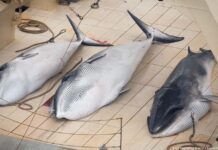
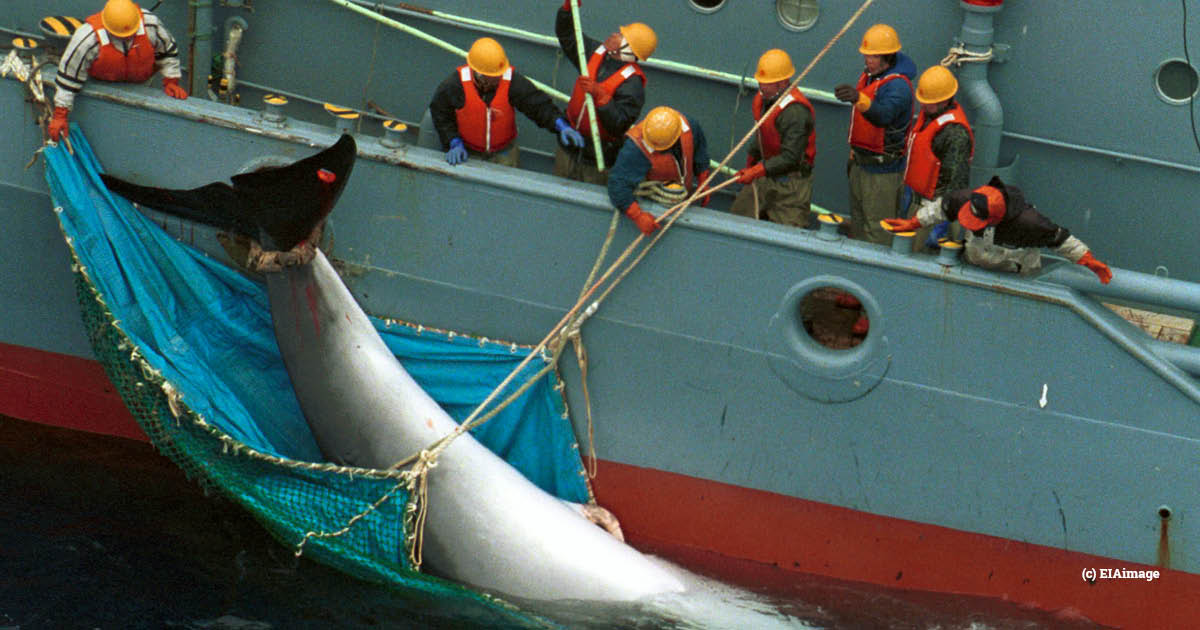
Despite the international ban, more than 1,000 whales are slaughtered with industrial harpoons every year by Norway, Iceland, and Japan. Yet, a single whale stores an average of 33 tons of carbon dioxide over its lifetime and, by nourishing the phytoplankton in the oceans, helps absorb 40% of the world’s carbon dioxide and produces at least 50% of the oxygen we breathe.
Our call to Türkiye: Vote “no” to commercial whaling resolutions
As Vegan Association of Türkiye (TVD), we issue the following call to the Turkish delegation, which joined the commission with the vision of “protecting marine mammals,” the Ministry of Agriculture and Forestry, and the General Directorate of Fisheries and Aquaculture:
- Vote NO to this dangerous resolution that aims to weaken the commercial whaling moratorium and violates the animals’ right to life and the spirit of international law.
- Vote YES to the establishment of the South Atlantic Whale Sanctuary, which has been proposed by Argentina, Brazil, and Uruguay for 28 years but continuously blocked by commercial lobbies.
- Stand against the anti-democratic “secret meetings” tradition in the IWC’s dark history and the “Commissioners-only” sessions where civil society and the media are forcibly removed. Defend the voice of civil society demanding transparency at the commission.
- Transparently announce your final stance at the meeting and the reasoning behind your votes to the public. Türkiye’s first vote at the commission must be on the side of the right to life, not commercial animal exploitation.
–
Sources: Yunuslara Özgürlük Platformu, The Guardian, Humane World for Animals, Uluslararası Adalet Divanı, WDC, Reuters
Cover photo: Environmental Investigation Agency (EIA)
–